
 Insights & Perspectives
How to reach teenagers without social media: the Gen Z & Gen Alpha non-media youth marketing guide
How do you reach teenagers without social media? Discover the levers of non-media youth marketing, DOOH and street marketing for Gen Z and Gen Alpha.
Quentin Tabernero
4 min read

6Table of Contents
- What does this mean for advertising aimed at teenagers?
- Rethinking visibility: the return of non-media strategy and DOOH
- Street marketing: creating an experience rather than a mere impression
- Guerrilla marketing: creating the right surprise
- Experiential marketing and local communication
- Editorial sources
How do you communicate with young people under the law of 24 August 2026 restricting access to social media? The question is now unavoidable for brands. Under-15s are among the most active audiences on social media and are quick to adopt new platforms. According to Awitec, this age group remains particularly present on TikTok, Instagram and Snapchat.
For advertisers, the message is clear: teenagers are not disappearing. But the way brands address them has to become more responsible, more creative and less dependent on algorithms. This is precisely where non-media marketing (events, field activations, out-of-home and DOOH) and youth marketing strategies come into their own.
What does this mean for advertising aimed at teenagers?
Age verification on social media is becoming a strategic issue for advertisers. For brands, the impact is twofold: on the one hand, self-declared targeting data is becoming less reliable; on the other, young audiences are becoming harder to measure and monetise.
Le Super Daily highlights the potential drop in reach and available audience data, as well as the growing need to invest in events, cultural partnerships and alternative environments.
Social media is not going away: it is simply no longer the automatic answer to every youth communication challenge.
Rethinking visibility: the return of non-media strategy and DOOH
To reach teenagers without social media, brands need to go back to a simple question: where do young people actually spend their time day to day?
Public transport, city centres, cultural venues, gyms, shops and leisure spaces all offer valuable opportunities to build a connection. Out-of-home (OOH) advertising makes it possible to build strong visibility without depending on individual user profiles.
DOOH (Digital Out-of-Home) adds a contextual dimension by adapting messages to the time of day, location, weather or peak footfall periods.
At ICS Agency, we select DOOH screens located in Gen Z catchment areas to maximise the return on investment of campaigns, notably thanks to ICS Maps, our proprietary geotargeting tool.
However, an effective campaign is not simply a matter of replacing an Instagram ad with a digital screen in the street. The message must be designed for its environment and for the attention time available.
Street marketing: creating an experience rather than a mere impression
Street marketing comes into its own when brands want to be sure of reaching the right audience and prompting real interactions with their target consumers.
For example, a street marketing operation can take the form of an interactive puzzle trail across several places young people frequent. Each stage offers a short, playful and concrete interaction: trying a product, taking on a challenge, customising an object or taking part in a useful experience.
The aim is not to force participants to share the experience online: a successful campaign works even if nobody posts it on social media. Memories, conversations and shared moments become the first indicators of success.
At ICS Agency, we draw on a large network of field ambassadors and brand promoters to bring brands to life through impactful, engaging and memorable activations across France.
Guerrilla marketing: creating the right surprise
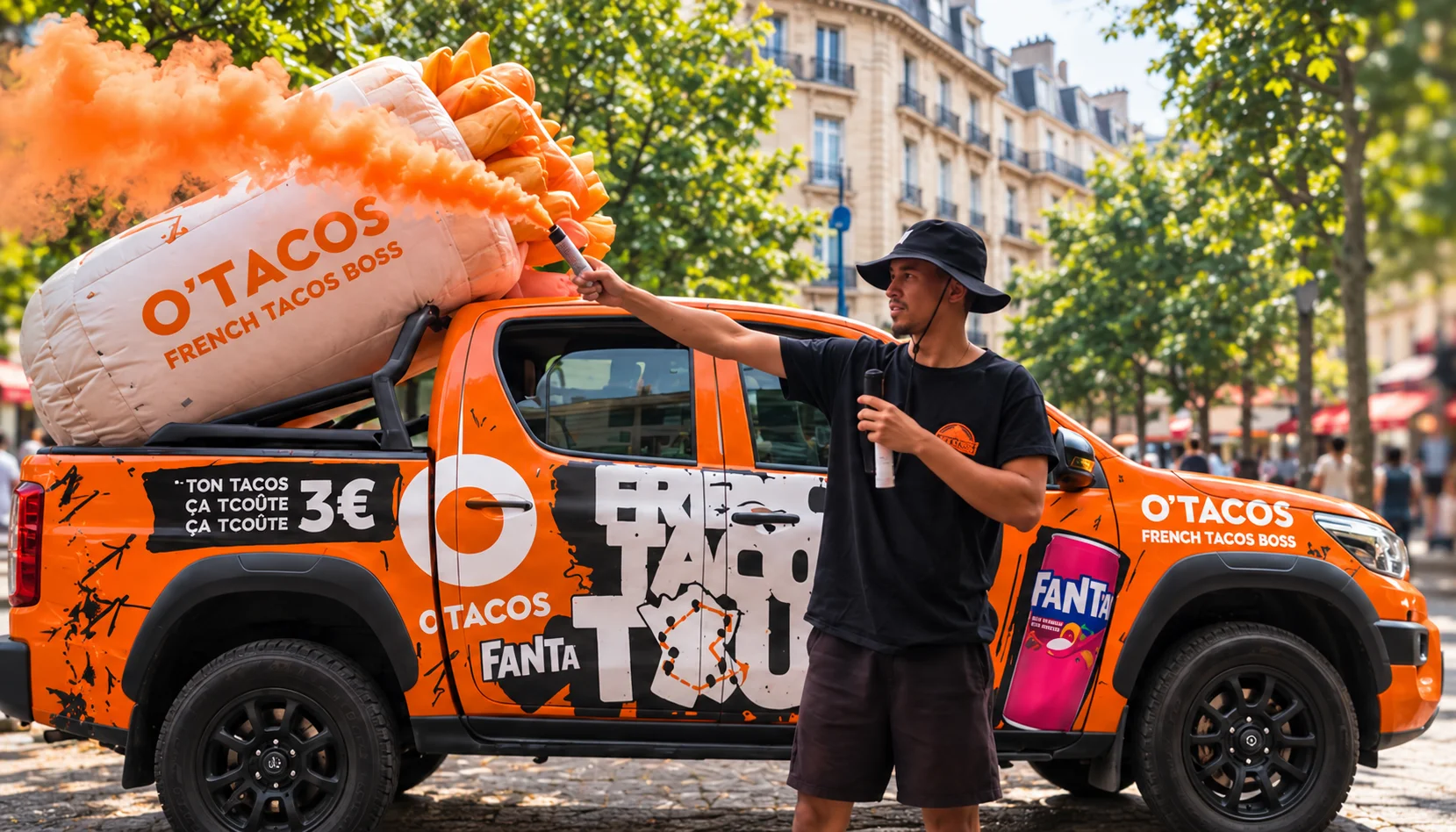
Guerrilla marketing can take the form of a temporary, authorised installation that turns an ordinary space into an unexpected experience.
A sports brand can set up a challenge zone in a high-traffic spot. A cultural brand can install a mobile mini-stage. A food brand can stage an immersive or themed tasting.
The principle of non-media marketing is to break from the everyday while respecting the place, the audience and the regulations in force. Surprise must never turn into commercial pressure.
Experiential marketing and local communication
Experiential marketing allows brands to make their promise tangible. A teenager can discover a campaign without following the brand, try a product without subscribing, and talk about the experience without posting it online. This freedom changes the nature of the relationship between brands and young consumers.
Event marketing relies on simple formats:
- a pop-up built around an artistic or sporting activity;
- a customisation workshop;
- a multi-city roadshow;
- a partnership with a cultural venue or a local shop;
- an activation combining discovery, play and practical usefulness.
This local communication is all the more effective when it fits naturally into local habits. An activation designed specifically for a neighbourhood, a city or a community appears far more credible than a standardised national campaign.
For brands, the challenge is to create an experience attractive enough to win over teenagers while remaining clear and reassuring for parents.
Non-media marketing thus establishes itself as a genuine alternative to social media: it does not try to recreate a news feed in the physical world, but builds a direct and authentic link between the brand and its audience.
A responsible youth marketing strategy rests on four key principles:
- Clearly distinguish between under-15s, 15-18 year olds and young adults.
- Ban pressure mechanics, artificial scarcity and excessive data collection.
- Involve parents when the product, venue or operation requires it.
- Measure the quality of the experience, not just the volume of contacts.
The fact that teenagers spend less time on social media does not mean brands should stop communicating with them. On the contrary, it invites them to imagine moments that do not require being constantly connected: an activity, a meeting, a discovery or simply an exchange in the real world.
At ICS Agency, we support brands through this transition. Our approach combines community analysis, marketing strategy, media planning, on- and offline media buying, street and retail marketing, stunt marketing, experiential marketing and performance measurement.
Discover the ICS Agency approach.
To turn this regulatory change into a creative opportunity, contact ICS Agency and let’s build your next youth communication campaign together.
Editorial sources
Blog du Modérateur · Awitec · Ado Zen · NEOW Kids · BlogNT · Le Super Daily – brands · Vie-publique · e-Enfance – regulation · Le Super Daily – debate · e-Enfance – age verification
You might also like
- Insights & Perspectives
 Street Marketing & Experiential
 Case Study & Influence